

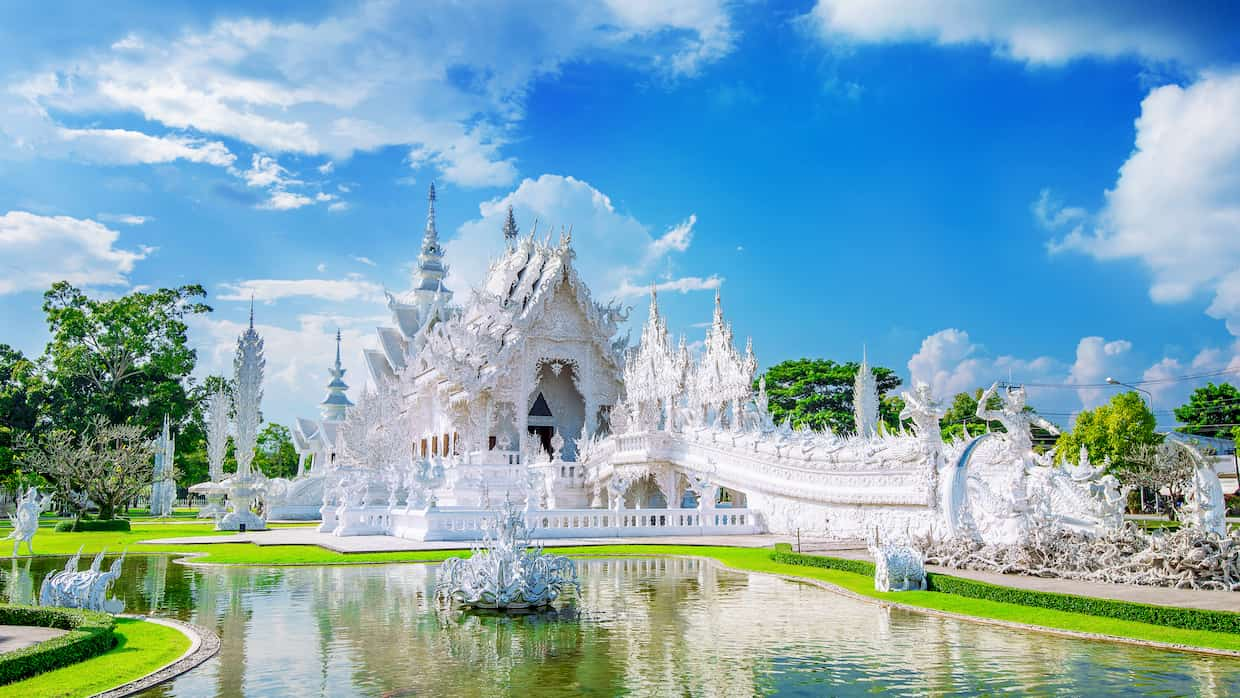
When you visit wat rong khun white temple, the first thing you notice is the colour.
White walls. White carvings. White sculptures catching the sunlight. Then the mirrors start to sparkle, and the whole temple almost seems to glow against the blue Chiang Rai sky.
And then you notice the hands.
Dozens of them reach out from the ground beneath the bridge leading to the main building. There are skulls, mythical creatures and plenty of details that make you stop and look again.
This is Wat Rong Khun, better known as the White Temple. It may look like an ancient Chiang Rai temple, but it isn’t. The temple was transformed by Thai artist Chalermchai Kositpipat from 1997 onwards and is really a huge piece of contemporary Buddhist art.
That is what makes it so interesting. You don’t simply walk around looking at an old building. Almost everything you see has a reason behind it.
Wat Rong Khun White Temple—The Path to Heaven
The bridge is probably the part of Wat Rong Khun that stays in your mind the longest.
Before reaching the main temple, you have to cross a white bridge surrounded by reaching hands. They aren’t there just to make the place look dramatic. They represent desire, greed and worldly attachment.
The idea is fairly simple. To reach enlightenment, you have to move beyond these temptations.
The bridge therefore becomes a symbolic journey. You leave the world of desire behind and move towards something purer.
Look at the temple itself and the same idea continues.
The white colour represents purity. Tiny pieces of mirrored glass catch the light and represent wisdom. The hands show uncontrolled desire, while the journey across the bridge represents the movement away from suffering.
This is the heart of the white temple. Once you understand it, the strange sculptures become much easier to appreciate.
Who Created Wat Rong Khun?
The white temple Chiang Rai artist is Chalermchai Kositpipat, a Thai artist who was born in Chiang Rai.
The original temple was in poor condition when Kositpipat decided to rebuild it. He didn’t want to carry out an ordinary restoration. Instead, he created his own vision of what a modern Buddhist temple could be.
Work began in 1997.
This makes his design quite distinct from the way most old temples in Thailand are designed.
Traditional Thai architecture is certainly present here, but it is combined with elaborate statues, symbols, and even contemporary art.
That is what makes the place seem so familiar at one point and so strange right after.
Yes, it is a temple, but it is also an artwork. More than that, as opposed to an ancient monument, it is actually a fairly new creation that keeps evolving.
What’s Inside the White Temple?
From outside, you might expect the interior to be covered in more white decoration. It isn’t quite what you expect.
Inside the main building, or ubosot, are Buddhist images and large murals created in Kositpipat’s distinctive style. The artwork includes traditional religious ideas but also modern references, making the white temple Chiang Rai inside experience very different from visiting an older Thai temple.
Some of the imagery can be surprising.
This is not an interior you should rush through just because you have already seen the famous exterior. Take a moment to look at the murals and details around you.
One practical point: photography is not allowed inside the main temple. So, for this part of the visit, you’ll have to leave the camera in your pocket.
The Golden Toilet at Wat Rong Khun
Then there is the building that catches everyone off guard.
It is golden.
And it is a toilet.
The golden building is actually a public toilet, and its colour fits neatly into the temple’s wider symbolism. The white buildings represent purity and the spiritual side of life, while gold is connected with material wealth and worldly desire.
It is a slightly amusing detail in an otherwise very serious artistic project.
After all the symbolism, sculptures and Buddhist imagery, finding such an elaborate toilet on the grounds is not something most visitors expect.
Wat Rong Khun Opening Hours and Entrance Fee
If you are looking up white temple Chiang Rai opening hours, Wat Rong Khun is generally open daily from 8:00 am to 5:00 pm.
The current entrance fee for foreign visitors is 200 baht. Older travel guides may still quote lower prices, so check the latest information before your visit.
| Visitor information | Details |
| Name | Wat Rong Khun |
| Also known as | White Temple |
| Location | Pa O Don Chai, Chiang Rai |
| Opening hours | Generally 8:00 am–5:00 pm |
| Foreign visitor fee | 200 baht |
| Artist | Chalermchai Kositpipat |
The complex is not enormous, but don’t judge the visit by its size. There are sculptures, smaller buildings and plenty of details around the main temple.
White Temple Chiang Rai Dress Code: What Should You Wear?
There is nothing complicated about the Chiang Rai White Temple dress code. As with other Buddhist temples, it is best to cover your shoulders and knees and avoid very short shorts, crop tops or revealing clothing. Light, loose clothes are a sensible choice too, especially when you are walking around outside in Chiang Rai’s heat.
Where Is the White Temple?
Wat Rong Khun sits around 13–14 kilometres south of Chiang Rai city centre, in Pa O Don Chai.
For anyone checking a white temple Chiang Rai map, search for Wat Rong Khun. You may also see the name written as vat rong kun, but it refers to the same place.
Drive time from the center of Chiang Rai is estimated to take about 20-30 minutes depending on traffic conditions. One can use a taxi, tuk-tuk, regular transport or one’s own vehicle to reach the temple site.
It also happens to be on the way for visitors who want to travel between Chiang Mai and Chiang Rai. For those planning an excursion in northern Thailand, it may well go along with the Chiang Mai elephant care experience or Doi Inthanon hiking Trip.
When Is the Best Time to Visit?
This is one place where getting there at the right time can make a difference.
Tour buses often arrive in the morning, especially as part of Chiang Mai–Chiang Rai day trips. An early visit can help you avoid some of the crowds. Late afternoon is another good option once many day-trippers have moved on.
The midday sun can also be intense. All that white reflects the light, so sunglasses, sunscreen and water are worth having.
Give yourself at least an hour. More if you like photography or want to examine the sculptures properly.
There is a lot going on here.
Don’t Confuse It With Other “White” Attractions
Travel searches can make things slightly confusing.
You may come across phrases such as white horse temple, silver temple Chiang Rai, Pai White Temple, white Buddha Chiang Rai or Chiang Rai big white Buddha while researching places in northern Thailand.
These do not all refer to Wat Rong Khun. Some are informal descriptions or searches for other attractions.
If you want the famous white temple south of Chiang Rai, the name you need is Wat Rong Khun.
Why Is Wat Rong Khun So Different?
Thailand has thousands of temples, so simply being beautiful isn’t enough to make one stand out.
Wat Rong Khun does this because it doesn’t look like it is trying to imitate the past.
The white architecture is unmistakable, but then you see the hands beneath the bridge. You notice the mirrors. You look inside and find modern imagery among Buddhist paintings. Then, somehow, the tour ends beside a golden toilet.
It is beautiful, but it is also odd.
And that’s part of its charm.
The white temple Chiang Rai Thailand experience works best when you don’t treat it as a quick photo stop. Look at the details. Think about what the artist is trying to say. Even the parts that seem strange are there for a reason.
FAQs
-
u003cstrongu003eWhy is Wat Rong Khun called the White Temple?u003c/strongu003e
The temple is predominantly white because the colour represents purity. Its surfaces are also decorated with small mirrored pieces that reflect sunlight and symbolise wisdom.
-
u003cstrongu003eWhat is the White Temple made of?u003c/strongu003e
The complex uses white plaster and architectural finishes, with extensive decorative work and small mirrored glass pieces incorporated into the structures.
-
u003cstrongu003eWho designed the White Temple?u003c/strongu003e
Chalermchai Kositpipat is the artist behind the modern Wat Rong Khun. He began rebuilding the temple complex in 1997.
-
u003cstrongu003eCan you take photographs inside Wat Rong Khun?u003c/strongu003e
Photography is not permitted inside the main temple hall. You can photograph the exterior, bridge and surrounding structures, subject to any restrictions displayed at the site.
-
u003cstrongu003eIs Wat Rong Khun worth visiting?u003c/strongu003e
Yes. If you’re travelling around Chiang Rai, it is one of the easiest places to add to your itinerary and one of the most unusual. The architecture alone is impressive, but understanding the symbolism gives the visit another layer.
-
u003cstrongu003eWhat is the White Temple Chiang Rai öffnungszeiten?u003c/strongu003e
Wat Rong Khun is generally open daily from u003cstrongu003e8:00 am to 5:00 pmu003c/strongu003e. Check the latest timings before visiting, as opening hours can change.
A Different Kind of Temple Visit
Wat Rong Khun is easy to remember.
You remember the brilliant white walls. The mirrors flashing in the sunlight. The hands reach up from the ground. The strange creatures. And, of course, the golden toilet.
But the real appeal goes beyond the photographs. Kositpipat used the temple to turn Buddhist ideas about desire, purity, wisdom and enlightenment into something visitors can actually walk through and see.
So take your time when you visit. Look beyond the famous façade, notice the smaller details and let the place be a little strange.
If you want to include the White Temple in a wider northern Thailand trip, Be Your Guides can help you plan the journey around the experiences you want to have.